The Challenge
Over recent decades, the organisation of manufacturing has become inseparable from international trade. Production has been progressively unbundled across borders into global value chains, in which intermediate inputs, components and raw materials are sourced wherever they are most readily or economically available. For Smart Manufacturing Networks, the security, diversity and predictability of imported inputs are therefore as important to competitiveness and continuity as price and quality. A succession of recent disruptions has exposed the fragility of this model and shifted the priorities of firms and policymakers from cost efficiency towards resilience. At the same time, geopolitical considerations increasingly shape trade relationships, so supplier risk can no longer be assessed on commercial criteria alone.
The European Union has responded by reframing its external economic policy around open strategic autonomy and economic security, including the systematic identification of strategic dependencies and the adoption of the Critical Raw Materials Act. This framework, however, operates at the level of sectors and raw-material categories, whereas a manufacturing enterprise’s exposure is determined by its specific sourcing footprint: which products it imports, from which supplier countries and how geopolitically proximate those countries are. The Smart Advisor bridges the gap between high-level policy ambition and intelligence that can inform operational decisions.
Closing this gap is difficult. A firm assessing its exposure faces more than 5,000 product categories at the six-digit Harmonized System level and bilateral relationships among more than 200 economies. It must also combine commercial, structural and geopolitical considerations that are rarely available in a single view. The difficulty is greatest for the small and medium-sized enterprises that form the backbone of European manufacturing and rarely have dedicated trade-intelligence capacity. Existing options do not resolve it: consultancy studies are expensive and not continuously updated; trade-data platforms as well as commercial aggregators, provide data access and high-level insight but no integrated advisory layer.
A static assessment is insufficient. Dependencies shift. Imports from a key supplier can decline, sourcing can become concentrated among fewer suppliers, or exposure can migrate towards politically distant countries. These changes are visible in monthly trade statistics but easy to miss without a baseline for what is normal. Manufacturers need both a structural picture of their exposure and continuous monitoring of how it changes.
Problem Solved
The Smart Advisor for the Alleviation of Critical Import Dependencies is a decision-support system for resilience and strategic sourcing in Smart Manufacturing Networks. Using global trade data, primarily from the UN Comtrade database, together with geopolitical indicators, it measures the concentration of import sourcing, assesses dependency and geopolitical risk at the level of individual products, and monitors trade flows to detect emerging supply disruptions. It has been developed by Policy Lab OÜ and is integrated into the NARRATE ecosystem through the Intelligent Manufacturing Custodian (IMC). The solution comprises three complementary modules.
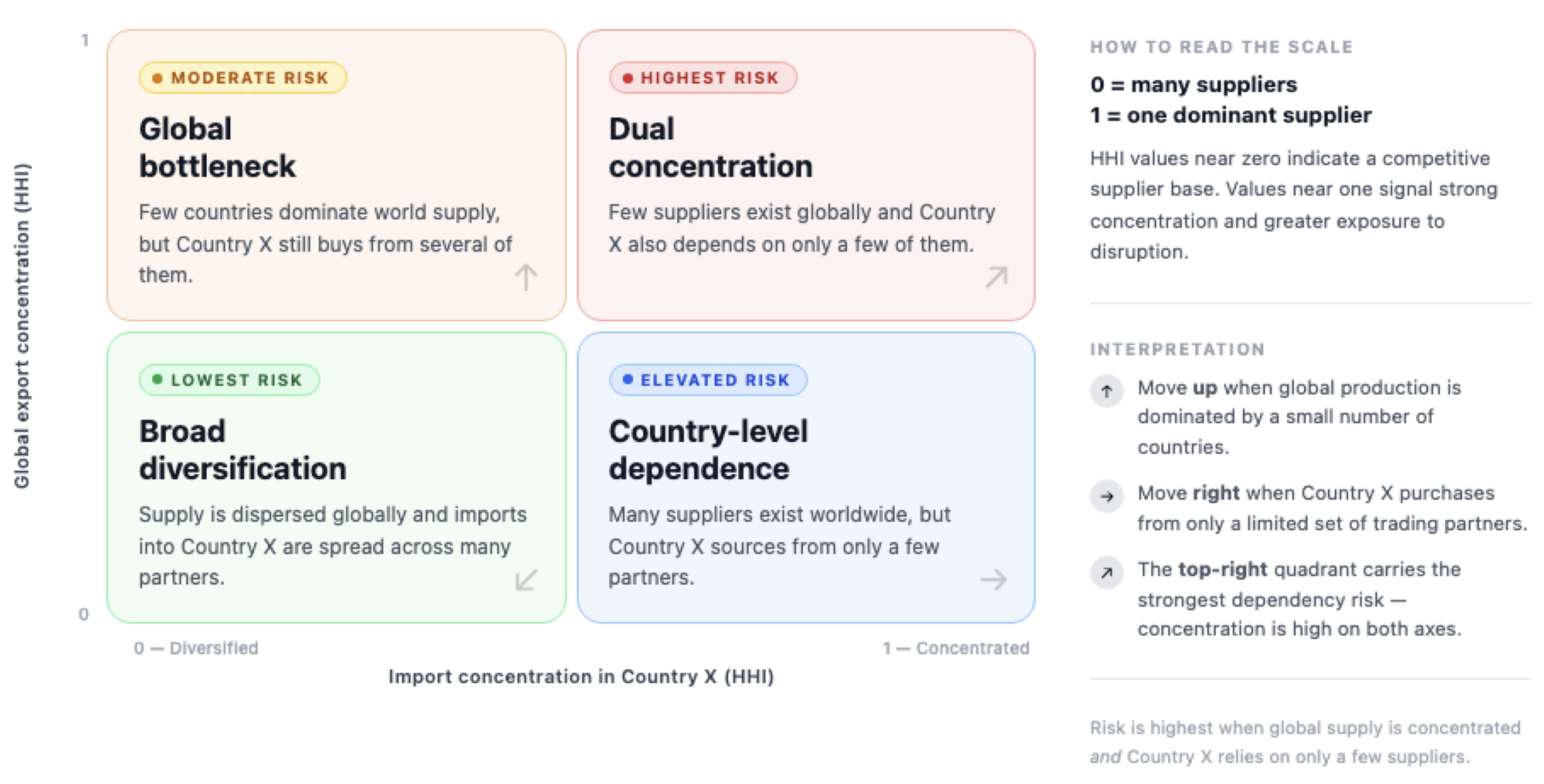
The Supply Chain Dependency Intelligence Module quantifies supplier concentration using the Herfindahl–Hirschman Index (HHI), calculated from the import shares of individual supplier countries. The index approaches zero when imports are evenly distributed across multiple countries and reaches one when a single country supplies the entire market. Assessing import concentration alongside the concentration of global supply distinguishes broad diversification from country-level dependence, global bottlenecks and dual concentration, in which only a few suppliers exist globally and the importing country relies on only a few of them (Figure 1). Each product also has an average geopolitical distance score, obtained by weighting the geopolitical distances of its three largest suppliers by their import shares, since a product may appear diversified while still carrying high geopolitical risk.
The Product-Level Import Dependency Module focuses on a single HS6 product and examines the bilateral structure of global trade flows in detail. It combines three analytical layers: supplier shares and import concentration; geopolitical distance scores, which classify each supplier as low, medium or high risk; and graph-based analysis using the Louvain community-detection algorithm, which identifies the community structure of the global trade network and potential diversification candidates within geopolitically closer communities. These layers are combined into a composite dependency risk score for each supplier, presented on an interactive world map.
The Import Disruption Detection Module monitors monthly trade data at the HS6 level against a historical baseline of normal import behaviour. It generates structured alerts for substantial reductions in imports from key supplier countries, significant increases in supplier concentration, rising exposure to geopolitically distant suppliers, and abrupt changes in trade flows that exceed normal historical variation. Alert thresholds can be adjusted to users’ requirements and risk tolerance. Where high-risk dependencies are identified, alternative supplier countries can be displayed to support mitigation.
The demonstrator relies on UN Comtrade, which provides harmonised bilateral trade data for more than 250 countries and territories and over 5,000 product categories at the six-digit HS level. Missing import records are estimated using the mirroring technique, in which a country’s unreported imports are derived from its partners’ reported exports. Geopolitical distance is derived from United Nations General Assembly voting records, using the established ideal-point estimates. The analytical pipeline is implemented in Python, with trade data retrieved through Policy Lab’s GoodTrade API, with network analysis performed and interactive visualisations produced. Results are made available to the IMC through a functional API.
Visuals & Architecture Diagrams