The Challenge
SMNs are intrisically dynamic, they can represent a supply chain in several different schemas with more or less resilience, associated costs and environmental impact. The Autonomous SMN Resilience Tool provides a service to the IMC to evaluate KPI of each SMN by applying stress conditions and impact on sustainabilty parameters.
Problem Solved
The Resilience, Sustainability and Circularity Stress Testing Tool (RSCST) is a graph-driven, API-oriented decision-support solution that uses operational information from the BMS semantic graph to assess resilience, sustainability, circularity, recovery and manufacturing performance across Smart Manufacturing Networks (SMN).
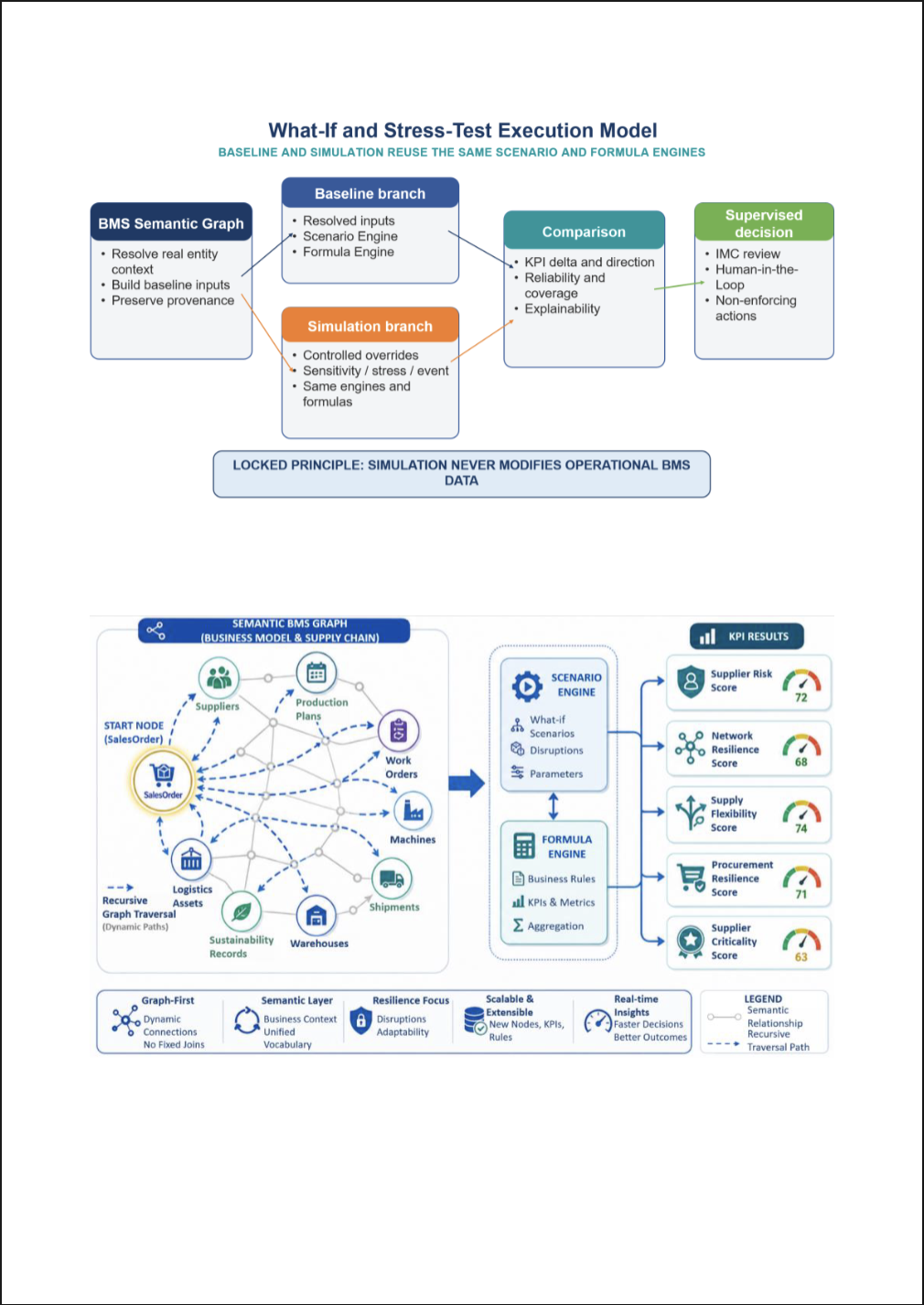
RSCST follows a Graph-First architecture. Rather than relying on fixed database queries, static object hierarchies or hardcoded property-to-class mappings, RSCST discovers business entities, attributes and relationships through the BMS semantic graph. The Graph Resolver and Domain Extractors transform graph evidence into analytical inputs consumed by the Scenario Engine and Formula Engine.
The analytical framework is scenario-driven and declarative. Scenario definitions contain input mappings, formulas, KPI definitions, normalisation rules and explainability configurations. This separation allows analytical models to evolve without redesigning the core execution engine and maintains traceability between source data, calculations and business interpretation.
RSCST can identify contributors, primary drivers, severity, affected areas, strengths, weaknesses and expected business impacts. It can also produce recommendations, prioritised action plans, executive summaries, trend analyses and ranked improvement opportunities.
RSCST supports proactive analysis through controlled What-If and stress-testing operations. Human operators, via IMC, can assess the effect of individual parameter changes, multiple stress levels, supplier outages, capacity reductions, shipment delays, combined operational changes and temporal profiles representing immediate shocks, progressive degradation, temporary disruption or staged recovery. Baseline and simulated cases use the same analytical logic, making their results directly comparable.
Simulation inputs are hypothetical and remain isolated from the operational baseline. RSCST does not write simulated values back to the BMS and does not claim that a simulated event was actually observed. Operational data remain under the control of the source systems and human operators.
Environmental capabilities are provided through an Environmental Adapter, a dedicated LCA microservice and openLCA. The solution supports process discovery, quantity-normalised assessments and the comparison of technically compatible environmental alternatives. Process selection remains subject to expert review of geography, technology, reference period, system boundary and allocation assumptions.
RSCST does not make autonomous operational decisions. It produces traceable assessments, simulations, evidence and non-enforcing recommendations for the IMC and human operators. Its capabilities are exposed through REST APIs documented using OpenAPI 3.1, Swagger UI and ReDoc, enabling controlled integration with the IMC.
Visuals & Architecture Diagrams