The Challenge
Manufacturing companies increasingly need to coordinate production across interconnected organisations, plants, suppliers and digital platforms. However, the information required for such coordination is usually fragmented across heterogeneous enterprise and operational systems, including ERP, MES, PLM, Digital Twin platforms and shop-floor data sources. These systems use different data models, interfaces and levels of detail. As a result, even a seemingly simple cross-system task, such as checking material availability, transferring an order into a Digital Twin representation, creating a work order or responding to a supplier disruption, may require several manual steps and repeated data interpretation.
This fragmentation limits the ability of Smart Manufacturing Networks to execute workflows consistently and at scale. Existing data may be technically accessible but not semantically aligned or suitable for direct use by intelligent applications. Product, process, resource, supplier, inventory and order information must be identified, transformed and placed into context before it can support question answering, planning or operational actions. Without a controlled integration layer, application developers must implement individual point-to-point connections. This increases integration effort, creates dependencies between systems and makes workflows difficult to trace, maintain and reuse.
Data confidentiality and sovereignty create an additional barrier. Real industrial ERP and production data frequently contain sensitive commercial information, personal data, supplier conditions or operational know-how. Such data cannot always be shared across a research consortium or used directly in a demonstrator. Nevertheless, the technical solution must be developed and validated with coherent data structures and realistic relationships between products, bills of materials, resources, suppliers, inventories and orders. A controlled and curated data foundation is therefore needed to enable integration work without exposing confidential company data.
Another challenge is the gap between a user’s operational intent and the technical services required to fulfil it. A user or an intelligent assistant may ask for the status of an order, request the creation of a work order or seek an alternative supplier after a disruption. Fulfilling this intent can require several coordinated operations: querying enterprise data, retrieving contextual blueprint information, validating inputs, transforming data, invoking the appropriate system interfaces and consolidating the result. If these steps remain disconnected, intelligent decision-support applications cannot reliably turn recommendations into traceable actions.
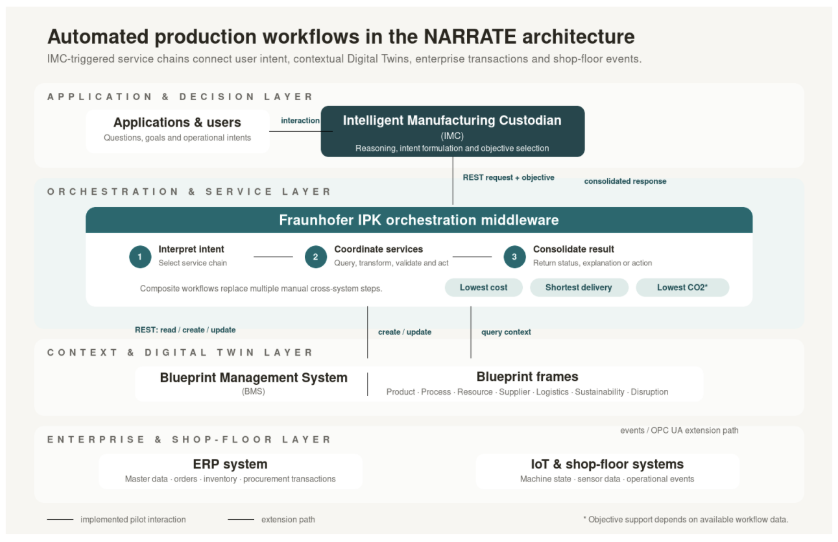
The innovation addresses these problems by providing a modular middleware and orchestration layer between enterprise systems, the Blueprint Management System and the Intelligent Manufacturing Custodian. It exposes REST-based services that retrieve, transform and synchronise data and combine individual operations into reusable workflow chains. In the NARRATE pilot, this supports ERP-to-blueprint transfer, IMC-triggered information retrieval, creation or updating of operational business objects and disruption-related supplier selection. The approach reduces manual cross-system work, separates application-level reasoning from integration logic and provides a reusable foundation for more resilient, transparent and adaptable manufacturing workflows. It also creates an extension path for event-driven shop-floor integration while avoiding claims that the current pilot already provides fully autonomous closed-loop control.
Problem Solved
The NARRATE Middleware for Blueprint-Based Production Workflow Orchestration is a modular, service-oriented integration and execution layer for Smart Manufacturing Networks. It connects enterprise data and transactions with contextual Digital Twin representations and intelligent applications.
At the enterprise layer, an ERP system provides authoritative master and transactional data, including products, bills of materials, resources, suppliers, inventory, procurement and production orders. Because real industrial data cannot always be shared, the pilot uses a curated, technically coherent ERP dataset representing the BUDATEC VS160 vacuum soldering use case. The same integration pattern can be mapped to authorised operational data in a deployment environment.
At the context layer, blueprint frames represent products, processes, resources, suppliers, logistics, sustainability information and disruptions. The Blueprint Management System manages these representations. In the implemented pilot path, the blueprints provide machine-interpretable context and may correspond to a Digital Model or Digital Shadow maturity level, depending on the available data connection. Bidirectional, autonomous shop-floor control remains an extension path rather than a claimed current capability.
The Fraunhofer IPK orchestration middleware forms the central service layer. REST-based interfaces encapsulate data retrieval, validation, transformation, synchronisation and operational actions. Composite services combine these functions into workflow chains, replacing multiple manual and system-specific steps. The Intelligent Manufacturing Custodian can formulate a structured request from a user’s question, goal or operational intent. The middleware interprets the request, selects and coordinates the required services and returns a consolidated result, status or action outcome.
Demonstrated scenarios include transferring ERP-derived information into blueprint-compatible structures, retrieving contextual information for IMC-triggered question answering, creating or updating work and procurement orders, and supporting disruption handling through replacement-supplier selection. Workflow objectives can include lowest cost or shortest delivery time. A lowest-CO2 objective can be used where the necessary emissions and supplier sustainability data are available.
The implementation follows a modular and container-oriented design with defined service interfaces and monitoring concepts. This supports traceability, extensibility and reuse while keeping responsibilities clear: enterprise systems remain authoritative for transactions, blueprints provide semantic context, the middleware handles integration and execution, and downstream applications perform planning, optimisation and decision support. The result is a transferable technical foundation for reducing integration effort and enabling more transparent, resilient and adaptable production workflows.
Visuals & Architecture Diagrams